
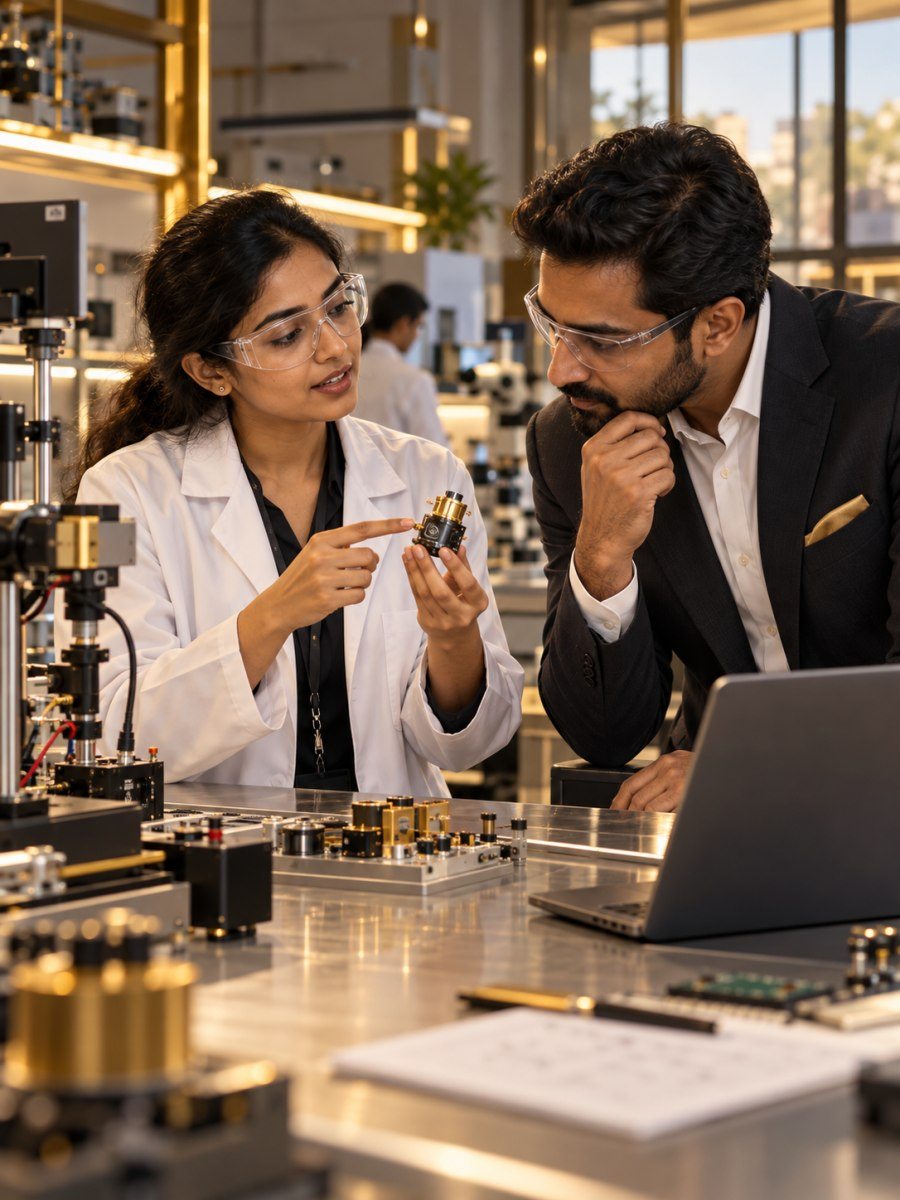
India’s research-to-business conversation received fresh attention at the sixth RISE Conclave in Kolkata. A PIB release dated 6 September 2026 described a gathering connecting researchers, startups, industry and government, with technology transfer and commercialisation among its themes. The event was scheduled for 6–7 September at CSIR-IICB.
The business question behind that announcement is familiar to many technical founders: what must happen between proving that something works and building an organisation that customers can buy from? The following is our practical analysis, not a claim that every participating venture has solved that challenge.
Define the buyer before the market size
A prototype can attract interest from several industries without having a clear first customer. Choose one application where the problem is expensive enough to matter and where a buyer can test the result. Identify the person who uses the product, the person who approves it and the person who controls the budget.
Those may be three different people. A plant engineer may like a monitoring device while procurement needs a supplier record and management wants evidence of a financial benefit. The product must survive that whole journey, not only the technical demonstration.
Design a pilot that can end with a decision
Agree on the baseline, duration, operating conditions and acceptance criteria before installing a trial. A vaguely defined pilot can continue for months without producing a purchase decision. A useful pilot gives both sides a way to say what was learned and what should happen next.
For a hypothetical industrial sensor, a pilot could examine whether the device produces sufficiently consistent readings in the customer’s environment. That is more informative than treating a successful laboratory demonstration as proof of factory readiness. The exact tests should be designed for the technology and its risks.
Price the work around the device
Manufacturing is only one part of delivery. Installation, calibration, training, maintenance and replacement arrangements can determine whether a customer is willing to adopt a new product. Estimate those responsibilities before promising a low unit price.
A founder should also understand which parts of the knowledge or design the business owns and which require permission. For a technology-transfer opportunity, take the proposed licensing terms to an appropriately qualified adviser rather than assuming that an introduction includes commercial rights.
Give a partnership an operating plan
Research institutions and businesses may work to different timetables. Write down who supplies equipment, who owns test data, how changes are approved and who supports a customer after installation. A partnership announcement is a starting point; the operating agreement makes the work manageable.
For founders outside established technology centres, a relevant research connection can widen the available capabilities. The value still depends on whether the parties can turn those capabilities into a reliable product and a clear customer offer.
The lab-to-market journey becomes more credible when it is described as a sequence of decisions, tests and responsibilities. That is the work behind a commercial breakthrough.
Cover illustration: original AI-generated editorial artwork created for BharatX Journal.